Project Title: Socio-cultural Determinants of health-seeking behavior among caregivers of children living with tuberculosis in informal settlements
Funding Agency: DOST-PCHRD/NRCP (12 mos)
Role: Project Leader
Abstract
With urban migration rapidly increasing and cheap housing remaining insufficient, a significant number of families take residence in informal settlements that are often situated in danger zones. From the ecological to the health threats, children are forced into these migrations and locations due to their dependency on their caregivers. Similarly, the extent of their resilience and recovery from these threats are significantly determined by the predisposition and decisions of their caregivers. Another layer to this social health fabric is the environment that equally informs the decisions of these caregivers and consequently determines the extent by which children are exposed to health threats and recovers from these when infected. Tuberculosis is the most prevalent communicable disease that has been documented to affect children in urban informal settlements as vulnerability to it is heightened by socio-ecological conditions which are prevalent in these areas such as congestion, pollution, and poor nutrition.
The 2016 National Tuberculosis Prevalence Survey provided two disturbing trends which included the increase of the vulnerability of the young population and the increase of TB cases in the National Capital Region. A key long term recommendation of the study is the development of locally-sensitive frameworks to address the intersection of poverty and community-based health-seeking behaviors. It is this call that this proposal answers to as it aims to explore the socio-cultural determinants of the health-seeking behavior among caregivers of children living with tuberculosis in informal settlements in the National Capital Region specifically Port Area, Payatas, and Bagong Silangan.
Drawing from Cultural Epidemiology that promoted the Explanatory Model Interview Catalogue (EMIC), this work will collect the illness and well-being narratives of children and their caregivers. Such framework in understanding disease allows for the localization of the understanding of disease and the treatments associated with it. This work will have three primary contributions: 1) Compared to previous studies that have utilized standardized instruments in collecting data on the health-seeking behavior of people living with tuberculosis, this work will develop locally-sensitive questionnaires that would allow for a more in-depth understanding of the lived experiences of the participants which may potentially support the development of more relevant programs and promotions for the community; 2) Another value of this study lies in its exploration of the limitedly inquired lived experiences of children which span from their vulnerability to the disease to their actual access of health services to achieve well-being; 3) Finally, this work will apply its findings in the development of locally-appropriate Information Dissemination Materials that will contribute to the reduction of risks and vulnerability among children to tuberculosis.
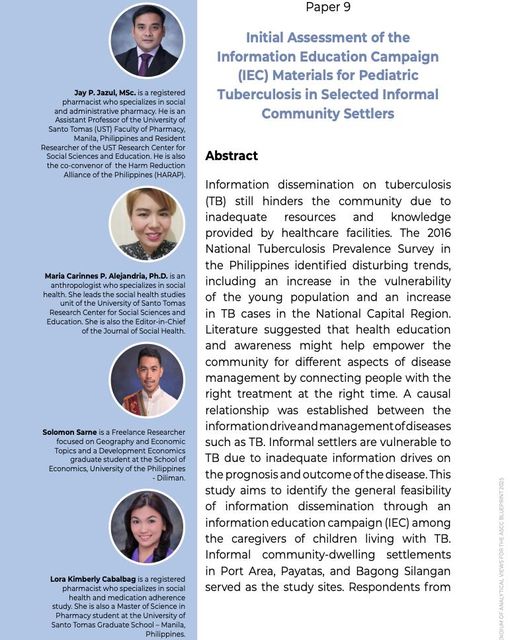
Our work on pediatric tuberculosis in 3 informal settlements in the National Capital Region was included in the Compendium of Analytical Views for The ASCC Blueprint 2025 which was published by the Association of Southeast Asian Nations.
You may read our work starting page 119.
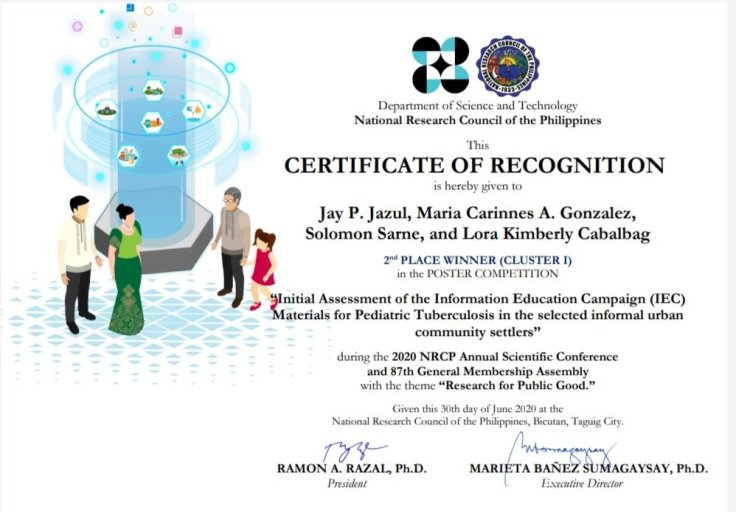
Our team conducted FGD in the three communities that participated in this study. The objective of the FGD was to validate the information, education, and communication materials for pediatric tuberculosis which are intended to be used both by the caregivers and the children. Three materials were developed: 1) an animated video, 2) a comic, and a calendar. One the copyrights for these materials are secured they will all be launch in all platforms for wider distribution.
FGD in Bagong Silang with the entire Social Health Studies team for Pediatric Tuberculosis. March 8, 2019
Fieldwork in Payatas for Pediatric TB project with the Social Health Studies team. FGD with caregivers and children. March 15, 2019
Fieldwork in Baseco for the past two days (january 12-13) has been extra challenging. Yesterday, a fire broke out in one of the blocks which reportedly left 60 families homeless. Three kids were also reported to have died in the fire. We had to cancel our afternoon FGD in anticipation of our participants unavailability. Today, we were surprised at the turn out of our participants who actively and eagerly engaged with us.




 Maria Carinnes P. Alejandria
Leave a comment